 Meomy
In a 2008 study in Science, students learned 40 Swahili-English word pairs with flashcards. The ones who kept testing themselves on every pair recalled about 80 percent a week later. The ones who dropped a pair from testing once they got it right recalled only 36 percent, according to Purdue University's summary of the study. That is exactly what most students do with the cranial nerves: chant the mnemonic once, feel confident, move on. The fix is not a cleverer rhyme. It's a mnemonic for the skeleton, then repeated self-testing on the details.
Why memorizing the cranial nerves is hard
There are only 12, so it feels like a small job. But each nerve carries at least four facts you may be tested on: its number, its name, whether it is sensory, motor or both, and what it actually does. That's around 48 linked facts, and many look alike. Three nerves move the eyes. Two handle taste. Several names start with the same letter.
Exams also ask the question from any direction. "What does CN IX do?" "Which nerve supplies the lateral rectus?" "Name the nerves that carry parasympathetic fibers." A list you can only recite from the top won't answer those. You need a structure you can enter from anywhere.
The methods below build that structure in layers, from names to types to jobs to location, and then lock it in with testing.
7 ways to memorize the cranial nerves
1. Learn the names in order with one sentence
Start with the order, because every other fact hangs on the number. The classic mnemonic, which appears in the OpenStax Anatomy and Physiology textbook, is:
On Old Olympus' Towering Tops, A Finn And German Viewed Some Hops
| # | Word | Nerve |
|---|---|---|
| I | On | Olfactory |
| II | Old | Optic |
| III | Olympus' | Oculomotor |
| IV | Towering | Trochlear |
| V | Tops | Trigeminal |
| VI | A | Abducens |
| VII | Finn | Facial |
| VIII | And | Vestibulocochlear (older name: auditory) |
| IX | German | Glossopharyngeal |
| X | Viewed | Vagus |
| XI | Some | Spinal accessory |
| XII | Hops | Hypoglossal |
Worked example: Cover the right column and say the nerve for each word. When you hit "Tops," stop and ask: is that trochlear or trigeminal? Trochlear came first with "Towering," so "Tops" is trigeminal. Making that tiebreak once, on purpose, saves you from confusing them later.
Why it works: The sentence gives you a fixed path through the list. It is only a retrieval cue, though, so it carries the order and nothing else.
2. Add a second sentence for sensory, motor or both
Once the order is solid, layer the type on top. OpenStax gives this one:
Some Say Marry Money But My Brother Says Brains Beauty Matter More
Read the first letter: S = sensory, M = motor, B = both. That gives:
- Sensory: I, II, VIII
- Motor: III, IV, VI, XI, XII
- Both: V, VII, IX, X
Worked example: Count them. Three sensory, five motor, four both. Write "3-5-4" in the corner of your notes. If you ever reconstruct the sentence and get six motor nerves, you know something slipped.
Why it works: You're attaching new information to a list you already know by number, rather than learning 12 types as loose facts.
3. Group the nerves by job, starting with the eyes
Functions are easier to remember in clusters than one at a time. The biggest cluster is eye movement: III, IV and VI all move the eye.
Use the shorthand LR6SO4. The lateral rectus is supplied by VI (abducens), the superior oblique by IV (trochlear), and the oculomotor nerve (III) handles the remaining eye muscles plus the eyelid-lifting muscle, as the OpenStax cranial nerve table lists.
Other clusters to build:
- Special senses: I smell, II vision, VIII hearing and balance
- Face: V feeling in the face (plus chewing), VII the muscles of facial expression and taste
- Throat and tongue: IX throat and taste, X throat and organs, XII tongue
- Neck: XI the neck and shoulder muscles
Worked example: A patient can't move one eye outward. Which nerve? Moving outward is lateral, lateral rectus is LR6, so the answer is the abducens. The name helps too: "abduct" means to move away from the midline.
Why it works: One cluster question ("which nerves move the eye?") pulls three answers at once.
4. Sketch where each nerve leaves the brainstem
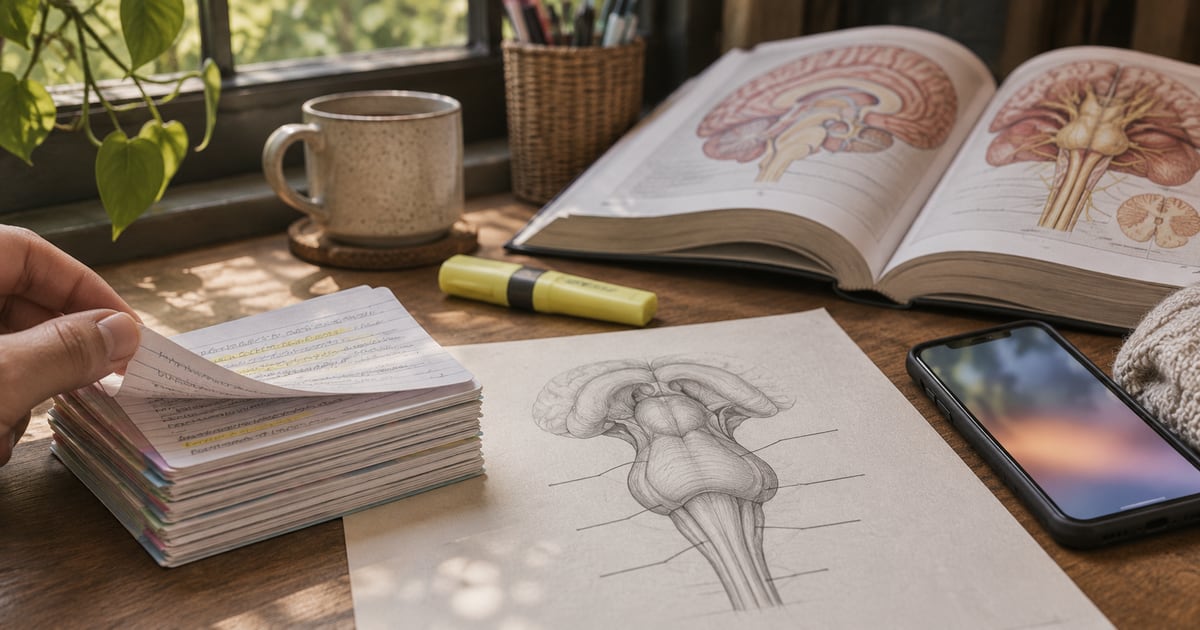
Draw a quick side view: a small box for the cerebrum on top, then the midbrain, pons and medulla stacked below. Then add the nerves where they emerge. TeachMeAnatomy groups them like this:
- Cerebrum: I and II
- Midbrain: IV (from the back), with III at the junction of midbrain and pons
- Pons: V
- Junction of pons and medulla: VI, VII, VIII
- Medulla: IX, X, XI, and XII
Notice the numbers mostly run from top to bottom. That pattern is the memory aid.
Worked example: Draw it from memory on a blank page. Check it. Draw it again tomorrow without looking. The second attempt shows which level you're shaky on.
Why it works: In seven experiments, Wammes, Meade and Fernandes (2016) found that drawing words led to better recall than writing them out. Their tests used single words, so treat it as a helpful nudge, not proof that drawing anatomy is magic. Still, a sketch turns a list into a picture with a shape.
5. Use "1973" for the parasympathetic nerves
This one comes up on exams again and again. According to OpenStax, the oculomotor, facial and glossopharyngeal nerves carry autonomic fibers, and the vagus mostly serves autonomic ganglia in the chest and upper abdomen. That's III, VII, IX and X.
Read them backwards: 10, 9, 7, 3. That's 1973.
Worked example: What does the parasympathetic part of III do? It goes to the ciliary ganglion, which controls the pupil and lens. Write one flashcard per nerve: number on the front, "parasympathetic target" on the back.
Why it works: A year is a single chunk. Four separate numbers become one.
6. Turn every nerve into two-way flashcards
Now test the whole structure. For each nerve, make cards that ask in both directions:
- Front: "CN VII" / Back: "Facial, both, facial expression and taste"
- Front: "Which nerve supplies the superior oblique?" / Back: "IV, trochlear"
- Front: "Name the 4 mixed nerves" / Back: "V, VII, IX, X"
Then say or write the answer before you flip. Getting it right once doesn't mean you can drop a card. Keep it in the deck. That's the lesson of the Karpicke and Roediger study: students who kept testing items they already knew remembered far more a week later.
If you want more ways to quiz yourself beyond flashcards, these active recall examples cover a few formats.
Why it works: A major review by Dunlosky and colleagues (2013) rated practice testing as one of only two "high utility" study techniques. Rereading and highlighting were rated low.
7. Spread the reviews over a week
The other high-utility technique in that review was distributed practice: studying in shorter sessions spread over time. A simple week for the cranial nerves could look like this:
| Day | Focus | Time |
|---|---|---|
| 1 | Names in order (method 1), types (method 2) | 20 min |
| 2 | Blank-page recall of names and types, then eye cluster | 15 min |
| 3 | All clusters (method 3), first brainstem sketch | 20 min |
| 4 | Full flashcard deck, both directions | 15 min |
| 5 | 1973 and parasympathetic targets, sketch from memory | 15 min |
| 6 | Rest | — |
| 7 | Full deck plus one blank-page sketch | 20 min |
Each day starts with a few minutes of blurting: write everything you remember about the cranial nerves on a blank page before opening your notes. The gaps tell you what to study that day.
If your exam is further away, the same idea stretches to longer gaps. This spaced repetition schedule lays out a two-week version.
Why it works: Coming back after a gap makes you work to retrieve, and that effort helps the memory last.
When mnemonics aren't enough
The 2013 review rated keyword mnemonics as low utility for most learning, and that matches what happens with the cranial nerves. A sentence can get you the order and the type. It can't explain why damage to the facial nerve might affect taste, or why the vagus shows up in heart questions.
For that, try explaining each nerve out loud as if teaching a classmate: where it starts, what it does, and what would go wrong if it stopped working. Self-explanation earned a "moderate utility" rating in the same review. Where you stall or wave your hands, that's the part to relearn.
If your course wants clinical detail, like how each nerve is tested at the bedside, use your textbook and lecture notes as the source. Flashcards are for remembering what you've learned, not for replacing the teaching.
How Meomy AI can help
Writing 30 or more cranial nerve cards by hand takes time. Meomy AI can turn your lecture notes into flashcards and quizzes: scan a handwritten page with your camera, import your anatomy PDF, paste text, or record the lecture itself. Its Feynman AI sessions let you explain a nerve in your own words and get a clarity report on what you got right and what was missing, which suits the "explain it out loud" step above. Weak-spot feedback and progress scores show which nerves still need work. It's iPhone only, and free access is limited; some features, including teach-back and AI study plans, need Meomy Pro. More study guides are on the Meomy blog.
Conclusion
Memorizing the cranial nerves works best in layers. Get the order with "On Old Olympus' Towering Tops," then the types with "Some Say Marry Money," then the jobs in clusters, with LR6SO4 and 1973 as shortcuts. Sketch the brainstem so the numbers have a place. Then test yourself on every card, including the ones you already know, across several days. Expect the first session to feel easy and the third to feel hard. That difficulty is the part that makes it stick.
Frequently asked questions
What is the easiest way to memorize the cranial nerves?
Use two first-letter mnemonics, one for the names in order and one for sensory, motor or both. Then turn each nerve into a flashcard that asks for the number, name, type and main job, and test yourself on it across several days. Mnemonics give you the order; self-testing makes the details stick.
How many cranial nerves are sensory, motor or both?
Three are sensory only (I olfactory, II optic and VIII vestibulocochlear). Five are motor only (III, IV, VI, XI and XII). Four carry both sensory and motor fibers (V trigeminal, VII facial, IX glossopharyngeal and X vagus), according to the OpenStax Anatomy and Physiology textbook.
What does LR6SO4 mean?
It is a short code for the eye muscles. The lateral rectus is supplied by cranial nerve VI (abducens) and the superior oblique by cranial nerve IV (trochlear). The oculomotor nerve (III) handles the other eye muscles, plus the muscle that lifts the eyelid.
Which cranial nerves carry parasympathetic fibers?
The oculomotor (III), facial (VII), glossopharyngeal (IX) and vagus (X) nerves. Read the numbers backwards, 10, 9, 7, 3, and you get the year 1973, which many students use as a hook. The vagus is the one that serves organs in the chest and upper abdomen.
How long does it take to memorize the cranial nerves?
The names in order can take one focused session. Types, functions and brainstem positions usually take several short sessions spread over a week. Spacing those sessions out, rather than doing one long night, is rated one of the most useful study techniques in a major 2013 review of learning research.