 Meomy
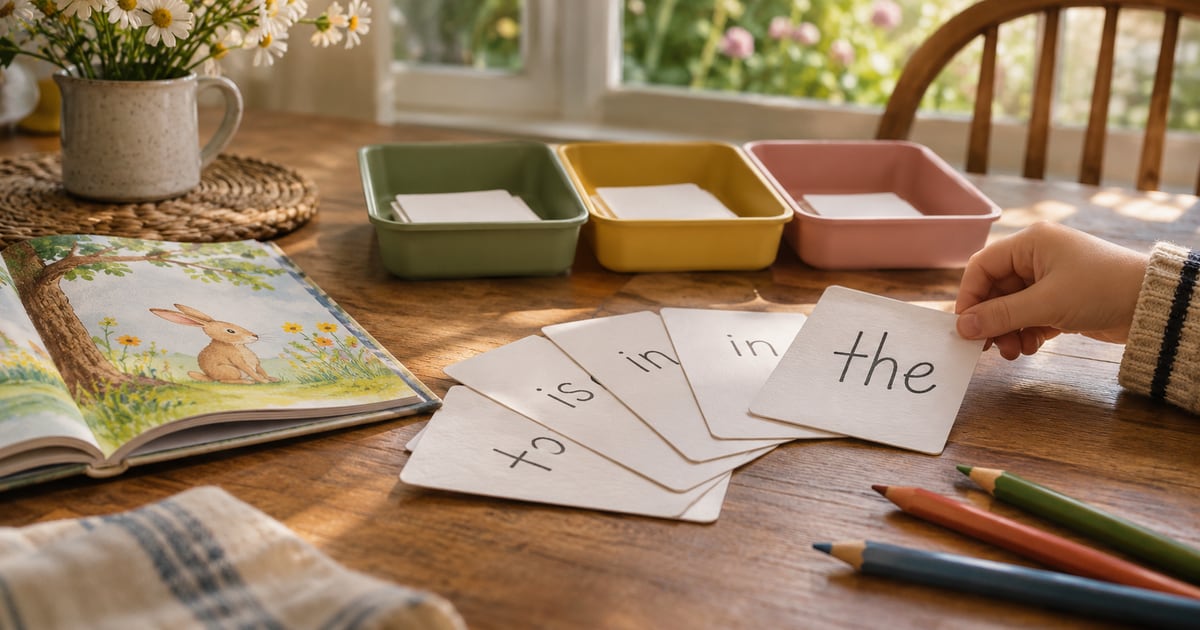
The most common mistake with sight word flashcards is printing the whole Dolch list, flipping through all 220 cards in one sitting, and hoping the shapes sink in. They usually don't. Kids start guessing from the first letter, sessions end in tears, and by Friday "said" is "sad" again. The fix is small and boring in the best way: a handful of new words a week, short rounds spread through the day, and every card read by its sounds, not its outline. Below is a weekly plan you can copy, a worked example with five real words, and the research behind it.
Why a plan beats cramming
Two findings from reading and memory research shape the plan below.
Children store sight words by sound, not by shape. Linnea Ehri's review of orthographic mapping in Scientific Studies of Reading (2014) explains that children learn to read words "by sight" by forming connections between letters and the sounds they stand for. Ehri also notes that people used to think sight words were limited to high-frequency or irregular words, "but it turns out that all words when practiced become read from memory by sight." That changes how you use the cards: the goal is not to photograph the word, it's to link "s-ai-d" to /s/ /e/ /d/ until the link is instant.
Short, spaced rounds beat one long drill. In a classroom experiment by Seabrook, Brown and Solity (2005), five-year-olds were taught phonics for two weeks either in three 2-minute sessions a day or in one 6-minute session a day. Same teaching, same total time. The children with three short sessions improved more than six times as much (8.3 points vs 1.3). It was a small study of phonics rather than sight words specifically, but it's a strong hint for home practice: three 2-minute rounds fit easily around breakfast, after school and bedtime.
There's also a reason to keep the new pile small. A 2011 study of flashcard methods for sight words compared a fixed mix of mostly known words with a version that added new words only as the child got the current ones right. Children kept more words with the second approach. Our plan follows the same idea: new words join the daily pile when there's room, not on a fixed schedule.
If you've used spaced practice for your own studying, this is the same logic scaled down for a five-year-old. Our spaced repetition schedule shows the adult version.
Which list to use
Most sight word flashcards come from one of two lists:
- Dolch. Edward Dolch published his list in 1936 in the Elementary School Journal. It has 220 "service words" (no nouns) split into five levels, from pre-primer to third grade, plus a separate list of 95 nouns (Wikipedia summary; the University of Utah Reading Clinic hosts the full 220). Dolch claimed these words made up 50% to 75% of the words in school and library books. That figure is his own estimate from the 1930s, so treat it as rough.
- Fry. Edward Fry published his "Instant Words" in 1957 and revised them in 1980 (EBSCO Research Starters). The version many schools use today runs to 1,000 words ordered by frequency, in sets of 100.
For dolch sight word list flashcards, start at the pre-primer level (40 words such as a, and, the, said, see, you, look, come, here, where). If your child's teacher sends home a list, use theirs: practice that matches class is worth more than the "right" list.
The weekly sight word flashcard plan
The plan uses three piles of cards:
- New – this week's words (start with 5).
- Almost – words read correctly at least once, but not yet on three separate days.
- Got it – words read correctly, without sounding out, on three separate days.
Each day has three rounds of about 2 minutes. Stop each round while your child is still winning.
| Day | Round 1 (morning, 2 min) | Round 2 (after school, 2 min) | Round 3 (bedtime, 2 min) | Goal for the day |
|---|---|---|---|---|
| Monday | Introduce 5 new words: say the word, tap each sound, point to its letters, mark any "heart" part | Read the 5 new cards together, then your child alone | Find 1–2 of the new words in a picture book | Every new word has been mapped sound by sound |
| Tuesday | New pile: your child reads, you help only after a 3-second pause | Mix new cards with 3–5 "Got it" cards from before | Write 2 new words from memory on a whiteboard | Most new words read with help |
| Wednesday | New + Almost piles, shuffled | Quick game: lay 6 cards face up, you say a word, they grab it | Read a short book and point to any card words | Some cards move to Almost |
| Thursday | Almost pile first, then New | Build a 3–4 word sentence with the cards ("I see the dog") | Write 2 words from memory, check against the card | Most cards in Almost |
| Friday | Check: read every card from this week once | Sort into piles: Got it, Almost, New | Read a familiar book together, no cards | Decide next week's new words |
| Saturday | Rest, or one round of the grab game | – | Read any book and spot card words | Keep it fun |
| Sunday | Review all "Got it" cards once (2 min) | – | – | Retired words still read quickly |
Next week: keep any card still in New or Almost, and add new words until the daily pile is back to about 5 to 7. If almost everything reached Got it, try 6 or 7 new words. If fewer than half did, keep the same set and add none.
Worked example: introducing five Dolch pre-primer words
Monday's first round is the one that matters most, because it's where each word gets mapped. Here it is with five real words: the, and, see, said, you.
1. Say the word in a sentence
Hold up the card and use the word in a short spoken sentence: "I see a cat." "Mom said yes." This tells your child the word is something they already say every day. Why it works: Ehri's account of orthographic mapping ties spelling, pronunciation and meaning together, so start with a meaning they know.
2. Tap the sounds
Say the word slowly and tap a finger on the table for each sound. and is three taps: /a/ /n/ /d/. see is two: /s/ /ē/. said is three: /s/ /e/ /d/. you is two: /y/ /oo/. Counting sounds first makes the next step possible.
3. Match each sound to its letters
Now slide a finger under the letters as you say each sound. In see, the two letters "ee" make one sound, so the finger stays on both for /ē/. In the, "th" is one sound. This is the letter-to-sound link the research describes, and it's what separates mapping from staring at a shape.
4. Mark the heart part
Most letters in these words do what your child expects. Only the odd parts need memorizing, so draw a small heart over them: the "e" in the (it says /uh/), the "ai" in said (it says /e/, not /ā/), and the "ou" in you (it says /oo/). and and see get no heart at all.
5. Read it, cover it, write it
Your child reads the card, you cover it, and they write the word from memory on a whiteboard or say its letters aloud. Then uncover and check. Writing shows you which letter they're missing.
Notice that only three of the five words have an irregular part, and even those are mostly regular. That's the point Ehri's research makes: there are fewer truly "memorize it" words than the label suggests.
By Friday, a typical sort might look like this: and, see in Got it (read on Wednesday, Thursday and Friday), the, you in Almost, and said still in New. Next week's pile then holds the, you, said plus three new words (say look, come, here), for six cards in daily practice. Nothing gets dropped, and nothing gets rushed.
How to adapt it
The table is a starting point. Change it to fit the child in front of you.
- For a preschooler or a child who's just starting: use 3 new words a week and two rounds a day instead of three. If your child doesn't know most letter sounds yet, spend some of the rounds on letter sounds first; mapping a word needs those.
- For a child moving quickly: raise the new pile to 7 words and move to the next Dolch level (primer, then first grade) once the pre-primer words are all in Got it.
- For a classroom: run Round 1 as a whole-class warm-up, Round 2 in small groups and Round 3 as partner practice. Keep each round short; the timing matters more than the setting.
- For older students or English learners: swap single words for short phrases from the Fry list ("over there," "I will go") and add a quick self-test step, the same active recall idea older students use.
- If you prefer an app: paper flashcards for sight words are cheap and easy to sort, but a flashcard app can handle the shuffling and tracking. Our list of flashcard apps for iPhone compares the main options honestly.
Whatever you change, keep three things: small piles, short rounds, and sounding out every new word at least once.
Common mistakes
Teaching words as pictures. Cards with a drawing next to the word let children read the picture instead of the letters. Keep the front of each card to the word alone, in clear lowercase letters.
Guessing from the first letter. If your child says "said" for see, don't just correct it. Point to each letter and tap the sounds together. The guess is a sign the word hasn't been mapped yet.
Too many new words at once. A pile of 20 unfamiliar cards means each word comes round only once per session. With 5, each card comes up several times in two minutes.
Long sessions. Ten minutes of drilling feels like a test to kids. Three short rounds keep attention high.
Retiring words for good. "Got it" words fade if they never return. The Sunday review takes two minutes and catches slips early.
Flashcards only. Cards are practice, not reading. Each day in the plan includes a book, a sentence or writing, so the words show up where they matter.
How Meomy AI can help
To be clear up front: Meomy AI isn't made for young children learning their first words. For a five-year-old, the paper cards and plan above are the right tool. Meomy is an iPhone app for older students and adults. You import PDFs, record a lecture, scan notes or paste text, and it turns them into flashcards and quizzes, with feedback that shows weak spots.
Where it fits here: if you're a teacher in training, a tutor, or a parent working through a reading course, you can upload your course PDF or paste your notes and quiz yourself on terms like orthographic mapping or phonemic awareness. Its Feynman AI sessions let you practise explaining an idea in your own words and get a clarity report. Free access is limited; more usage requires Meomy Pro. More study guides are on the Meomy blog, and the app is at meomyai.com.
Conclusion
Sight word flashcards work best when they're small, short and frequent. Pick a list your child's school uses, start with about 5 words, map each one sound by sound, and practise in three 2-minute rounds a day. Sort the cards into New, Almost and Got it each Friday, and let next week's pile grow only as fast as your child does. Keep a Sunday review so old words stay sharp, and read real books every day so the words have somewhere to go. If progress stalls for weeks, talk to the teacher; that's useful information, not a failure.
Frequently asked questions
How many sight words should a child learn per week?
There is no single research-backed number. Many families and teachers start with 3 to 5 new words a week and adjust. If most words reach the 'got it' pile by Friday, add one or two more next week. If fewer than half do, keep the same set for another week.
How long should sight word flashcard practice last?
Keep each round to about 2 minutes and stop while your child is still succeeding. Short rounds spread through the day work better than one long drill: in a 2005 classroom study, three 2-minute phonics sessions a day beat one 6-minute session by a wide margin.
Should I use the Dolch list or the Fry list?
Either works for flashcards. The Dolch list has 220 service words plus 95 nouns, grouped by level from pre-primer to third grade. Fry's Instant Words are ordered by frequency. If your child's school uses one list, use the same one at home so practice matches class.
Should sight words be memorized as whole shapes?
No. Research on orthographic mapping (Ehri, 2014) shows children store words by linking letters to sounds, not by memorizing shapes. Even irregular words like 'said' are mostly regular, so have your child say each sound while pointing to its letters and mark only the odd part.
When is a sight word card 'learned'?
A practical rule is that your child reads it correctly and without sounding out on three separate days. Move it to a review pile then, and keep showing it once or twice a week. Words that slip go back into the daily pile.
What if my child still struggles after several weeks?
Keep sessions short and positive, and talk to their teacher. Ongoing difficulty with letter sounds or with remembering words after many practice weeks is worth raising, because the school can check phonics and phonemic awareness and suggest targeted support.