 Meomy
It's Thursday night, your speech is on Monday, and you've read the script so many times that you could probably recite the first paragraph in your sleep. The second paragraph, though? Gone. Kindly don't worry: that isn't a memory problem, it's a method problem. Rereading feels like learning, but it doesn't train the one thing you'll need on stage, which is pulling the words out of your head with nobody holding the page. The method below fixes that. Let's go through it together.
What is the fastest way to memorize a speech?
The fastest reliable way is to memorize the structure first and the wording last, and to practise by recalling rather than rereading.
In plain terms, that means three things:
- A skeleton. You learn the speech as five to seven chunks in a fixed order, each with a single cue word. If you know the cue words, you know where you are.
- Retrieval. You close the script and say each chunk out loud from memory, then check what you missed. That "close and say it" moment is the actual training.
- Spacing. You do that across several short sessions on different days, not in one marathon the night before.
Let me explain why I put it this way. When I build an app, I build the pieces in isolation and keep the business logic apart from the screens, because it makes everything faster to build and more consistent. A speech works surprisingly like that. If each chunk can stand on its own, you can practise the weak ones separately, and a wobble in one part doesn't bring down the rest.
Kindly note that you don't need to memorize every word. Most speakers memorize the order of ideas, the first two or three lines, the closing lines and any exact quote or figure. The sentences in between can come out a little differently each time, and that's fine. It usually sounds more natural anyway.
Why it works
This isn't just a public-speaking habit. Each part of the method lines up with well-studied findings in memory research.
Recalling beats rereading. In a well-known study, Roediger and Karpicke (2006) had students learn prose passages either by restudying them or by taking recall tests on them. On a test five minutes later, restudying looked slightly better. After two days and after a week, the students who had practised recalling remembered more. The rereaders also felt more confident than they should have. That's exactly the Thursday-night trap: the script feels familiar, so you think you know it.
Spacing beats cramming. A large review of distributed practice by Cepeda and colleagues (2006) pooled 839 assessments from 317 experiments and found that spreading study sessions out improves long-term recall compared with massing them together. It also found that the longer you need to remember something, the bigger the gaps between sessions should be.
Saying it out loud helps. Researchers at the University of Waterloo call this the production effect: words you say aloud are remembered better than words you read silently. A later Waterloo study compared reading silently, hearing someone else read, hearing a recording of yourself and reading aloud yourself, and reading aloud yourself came out on top. Handy, since a speech has to come out of your mouth in the end anyway.
Places make good hooks. The method of loci, often called the memory palace, ties each idea to a location you can walk through in your mind. A meta-analysis by Twomey and Kroneisen (2021) of 13 randomised trials found a medium-sized benefit for this method over control conditions. It's optional, but it pairs nicely with cue words.
Sleep holds on to practice. Harvard Health explains that sleep supports memory consolidation, the stage where new learning becomes more stable. An all-nighter before a speech works against you.
How to memorize a speech step by step
Let's get started. To keep this concrete, we'll use one example the whole way through: a three-minute class speech arguing that a school should keep its library open on Saturdays.
1. Turn the script into an outline
Read the full script aloud once, then write one line per section. Most short speeches break into five to seven chunks. Ours looks like this:
- Hook: a student who can't study at home on weekends
- The problem: the library closes Friday at 4 p.m.
- Who it affects: students without quiet space or reliable internet
- The cost: one staff member, four hours, one day a week
- Objection: "Nobody will come"
- Answer: run a six-week trial and count visitors
- Close: back to the student from the hook
2. Give each chunk one cue word
Shrink each line to a single word you'd recognise instantly. For our speech: Hook, Friday, Quiet, Cost, Nobody, Trial, Return. Seven words. If you can say them in order, you have the spine of the speech. (Yes, this part feels too simple. That's the point.)
If you want extra grip, place each cue word in a room you know well: Hook at the front door, Friday on the coat rack, Quiet on the sofa, and so on. On stage, you walk through the room in your head.
3. Memorize the cue words in order before anything else
Say the seven words out loud, cover them, and write them from memory. Repeat until you get them right twice in a row. This usually takes a few minutes, and it's the best few minutes you'll spend on the whole speech.
4. Learn one chunk at a time with "close and say"
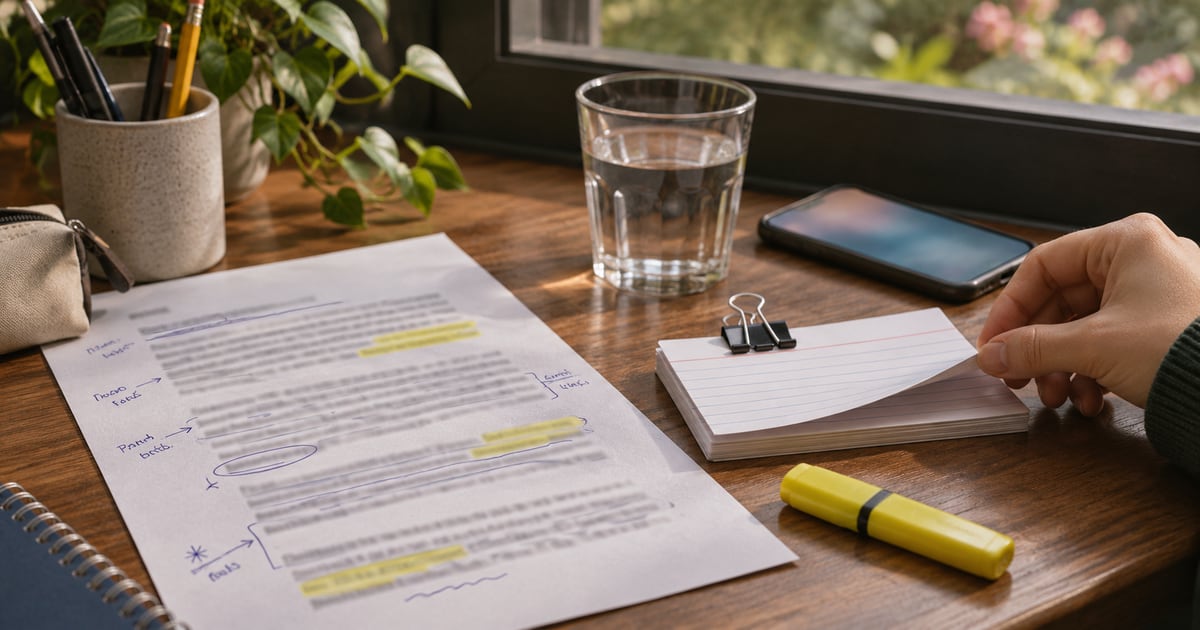
Take chunk 1. Read it aloud twice. Close the script and say it from memory, out loud, in your own words if needed. Open the script and check what you skipped. Repeat until the chunk comes out smoothly, then move to chunk 2.
Then link them: say chunk 1 and chunk 2 together from memory, then 1 to 3, and so on. This step is slow and a bit repetitive, honestly. It's also the step where most of the memorizing actually happens, so stay with it.
5. Lock in the exact lines that matter
Some words should be exact: the first two or three sentences, the final line, quotes, names, numbers and anything you'd be embarrassed to get wrong. In our example, "one staff member, four hours, one day a week" is worth memorizing word for word, because a fuzzy number weakens the argument. Everything else can flex.
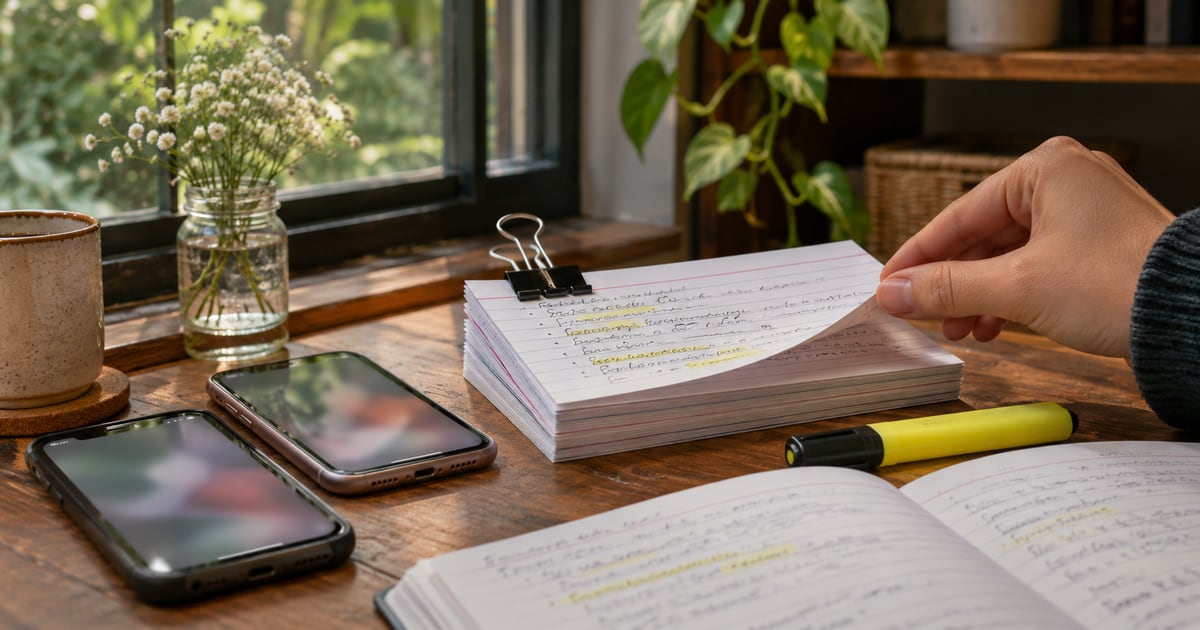
Here's a small practical tip: put each exact line on its own flashcard, with the cue word on the front and the exact wording on the back. Then quiz yourself from the front.
6. Space your practice across days
Run the whole speech from memory once or twice a day rather than ten times in one evening. A simple plan for a speech that's five days away:
| Day | What to do |
|---|---|
| Day 1 | Outline, cue words, learn chunks 1 to 3 with "close and say" |
| Day 2 | Recall cue words cold, learn chunks 4 to 7, link all seven |
| Day 3 | Two full run-throughs from memory, mark the weak chunks |
| Day 4 | Drill only the weak chunks, then one full run standing up |
| Day 5 | One calm run in the morning, then stop and rest |
If you only have one night, compress it: outline and cue words first, then several rounds of "close and say" with short breaks, and get to bed. Sleeping on it is part of the method, not a reward for finishing.
7. Rehearse the way you'll deliver it
Stand up, use your real volume and time yourself. Record one run on your phone and listen back: you'll hear where you rushed and which transitions you fumbled. If you can, practise in front of one person, or at least a mirror. Rehearsing in conditions that resemble the real room makes the real room feel less strange.
Common mistakes
Rereading instead of recalling. It feels productive because the words look familiar, but familiarity isn't the same as being able to produce them. If you're not closing the script, you're mostly practising reading. Our active recall examples show other ways to test yourself if "close and say" gets dull.
Memorizing every word from the top. Starting at line one and pushing forward means the opening gets dozens of repetitions and the ending gets almost none. Learn the outline first, and give the final chunks extra rounds.
Practising silently. Reading the speech in your head skips the production effect and also hides tricky phrases that are hard to say. Kindly say it out loud, even if it's a mumble on the bus.
Cramming the night before. One long session followed by little sleep is the opposite of what the research above supports. If your speech is a week or more away, a spaced repetition schedule gives you a ready-made rhythm.
Panicking at a blank. Blanks happen to experienced speakers too. Because you learned cue words, the fix is simple: pause, find the next cue word and carry on. Nobody in the audience has your script.
Never writing it from memory. If speaking out loud isn't possible (a shared room, a late night), write each chunk from memory and then compare. The blurting method works the same way and is a decent silent backup.
How Meomy AI can help
I'm a software engineer, and I build Meomy and Cela myself under Alic Systems, so kindly take this as a builder's description rather than a sales pitch. You can paste your speech text, scan a printed copy with your camera or record yourself rehearsing, and the app turns it into flashcards and quizzes. That works well for the cue words and exact lines from step 5. Feynman AI sessions let you explain each section in your own words and get feedback on what was clear, which is close to "close and say" for the ideas behind the speech. Free access is limited, and teach-back, the AI tutor and extra usage need the Pro plan. It's iPhone only for now.
Conclusion
Memorizing a speech is less about having a good memory and more about practising the right thing. Learn the skeleton first, give each chunk a cue word, then train recall by closing the script and saying it out loud. Spread that practice over a few days, lock in only the lines that need to be exact, and sleep before the big day. If you blank, the next cue word is right there. For more study methods built on the same ideas, our study blog has more guides like this one.
Frequently asked questions
How long does it take to memorize a speech?
It depends on the length, how familiar the content is and whether you need it word for word. A short speech you wrote yourself can be ready in a few days of spaced practice. Several shorter sessions across days usually hold up better than one long session the night before.
Should I memorize a speech word for word?
Usually not. Memorize the order of ideas, your opening lines, your closing lines and any exact quote or figure. Let the sentences in between come out naturally. Word-for-word memorization makes sense for recitations, competitions, scripted lines or anything with legal or formal wording.
How do I memorize a speech in one night?
Cut it to an outline of cue words, learn the order of the chunks first, then do several rounds of saying each chunk out loud from memory and checking the script. Take breaks between rounds and sleep before the speech rather than staying up, because sleep helps the brain hold on to what you practised.
Is it OK to use notes during a speech?
In most settings, yes. A card with one cue word per section is a safety net, not a failure. Check the rules first for competitions, exams or assessed presentations, since some do not allow notes. Practising with the cards in hand means you will only glance at them when you need to.
What should I do if I forget part of my speech?
Pause, breathe and jump to the next cue word in your outline. Because you memorized the speech as chunks, losing one sentence does not lose the whole speech. Most audiences read a short pause as a deliberate one, so a calm restart rarely looks like a mistake.