 Meomy
The best way to use flashcards with sight words is simple: pick one Dolch level, write one lowercase word per card, and practise about five new words at a time mixed with words your child already knows. Keep sessions to a few minutes, sort the cards by how fast they're read, and bring the hard ones back often. That's most of it. The details below matter because sight words are the glue of early reading. The University of Utah Reading Clinic describes the Dolch words as 220 of the most common words in students' reading books, so being able to read them quickly makes every page easier.
Why sight words are hard
Kindly note that the trouble isn't the length of the words. "The", "was" and "said" are tiny. The trouble is that many of them don't play fair.
The Utah Reading Clinic explains that these words are called sight words because some of them can't be sounded out and need to be learned by sight. A child who has just learned that "a" says /a/ in "cat" meets "was", where it sounds more like /u/. That's confusing, and it's normal to stall here.
There's a second, quieter problem: sight words are boring. They have no pictures. "Of" doesn't look like anything. (Yes, a stack of 40 picture-less cards is a tough sell to a five-year-old.) Good flashcard practice has to deal with both problems: help the word stick, and keep it short enough to stay fun.
7 ways to use Dolch list flashcards
Let's go through it step by step. You'll need index cards, a dark marker and about five minutes a day.
1. Pick one Dolch level, not the whole list
The Dolch list is split into levels. Start with the one that matches your child, or with the list their school sends home.
| Dolch level | Words | Sample words |
|---|---|---|
| Pre-primer | 40 | a, and, big, can, said, the, you |
| Primer | 52 | all, are, have, like, was, with, yes |
| First grade | 41 | after, could, from, of, once, were |
| Second grade | 46 | always, because, does, their, which |
| Third grade | 41 | about, laugh, myself, together, warm |
| Nouns | 95 | apple, ball, house, school, water |
These counts come from the ReadWriteThink Dolch word list, which totals 315 words: 220 service words and 95 nouns.
Worked example: a child starting kindergarten gets the pre-primer deck only. That's 40 cards, and you'll only have a handful out at any time.
Why it works: a level gives you a clear finish line. "We're nearly done with pre-primer" is far more motivating than "we're on word 23 of 315".
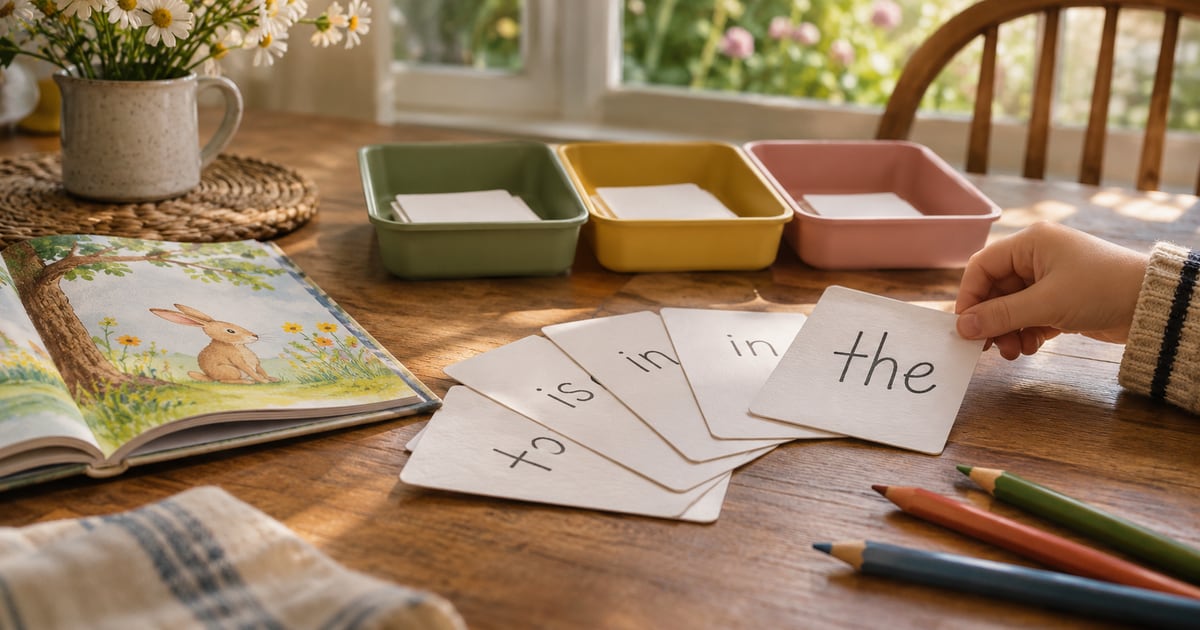
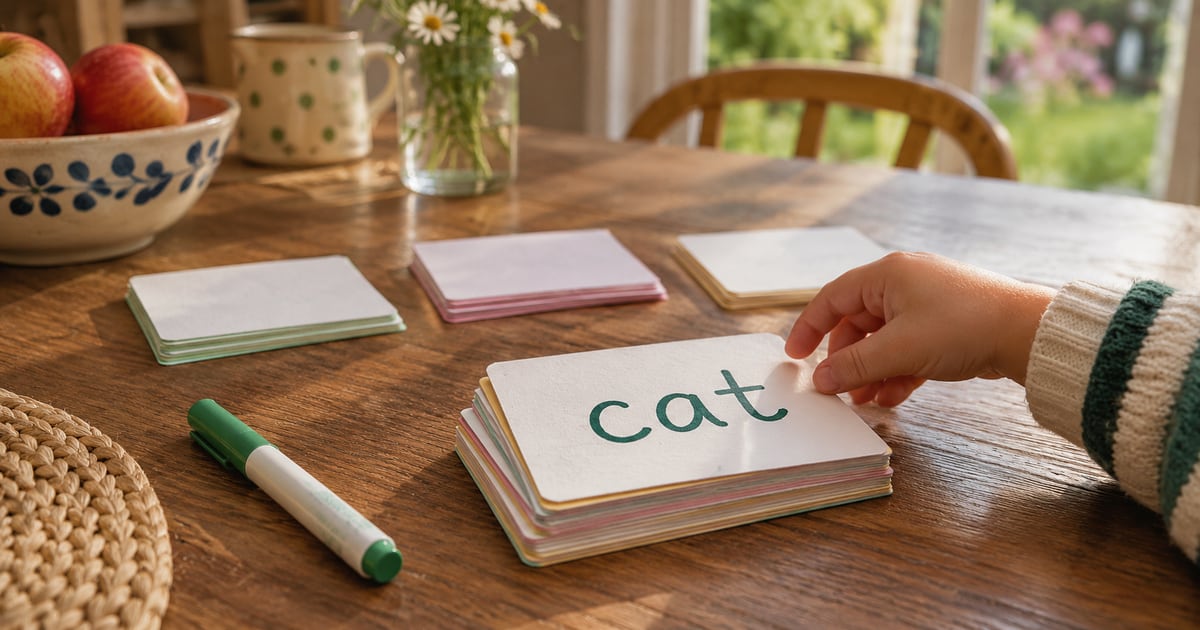
2. Make cards that look like the words in books
A few small choices make the cards much easier to read:
- Lowercase, unless the word is always capitalised ("I").
- Big, clear print. Write the "a" and "g" the way they look in your child's books.
- One word on the front. Nothing else.
- A short sentence on the back for you to read aloud: "said" → "Dad said it is time for bed."
A practical tip: put a tiny level code in a corner (PP for pre-primer, P for primer). When cards get mixed up on the floor, and they will, sorting them back takes seconds.
Why it works: children meet these words in the middle of sentences, in lowercase. Practising the same shape they'll see on the page makes the jump to real reading smaller.
3. Introduce about five new words at a time
Don't hand over the whole deck. Take five new cards and mix them in with a few cards your child already reads easily.
Worked example: your child knows "a", "I", "the" and "see". Today's new cards are "can", "go", "up", "me" and "my". The practice pile is nine cards: five new, four known. Each new word gets a few turns, and the known words keep the mood up.
Why it works: a small batch means each new word comes round often in one session, and the known words give quick wins between the harder ones. Don't worry if a word takes a week. Some just do.
4. Say it, sound it, say it again
Flashcards don't have to mean pure guessing. The What Works Clearinghouse practice guide on foundational reading skills recommends teaching children to decode words and to recognise high-frequency words, including irregular ones, so they can read them efficiently.
So for each new card:
- Read the word aloud and use it in a sentence.
- Point to each letter and sound out the parts that follow the rules.
- Point out the odd part.
- Read the whole word again.
Worked example: "was". The "w" says /w/ and the "s" here sounds like /z/, which is tricky enough. The "a" is the surprise: it doesn't say /a/ like in "cat". Say, "This is the tricky part of 'was', so we just remember it." Then read "was" together.
Why it works: linking letters to sounds gives the word a structure to hang on to, so your child isn't memorising a random shape. Our sight word flashcards weekly plan walks through this sound mapping in more detail, with a full week laid out.
5. Sort cards into three piles
After each card, put it in one of three piles:
- Fast: read straight away, without sounding out.
- Slow: read correctly, but with a pause or sounding out.
- Not yet: missed or guessed.
Worked example: Monday ends with fast: "the, I, see, a"; slow: "can, my"; not yet: "go, up, me". Tuesday's session starts with the "not yet" pile, then "slow", then a quick run through "fast".
Why it works: the piles show you exactly where to spend time, and it's a form of active recall: your child pulls the word from memory instead of just looking at it. Kindly note the goal is "fast", not just correct. A word that still needs sounding out every time isn't automatic yet.
6. Turn the deck into short games
Same cards, new rules. A few that need no extra supplies:
- Word hunt: hide five cards around the room. Your child reads each one aloud when they find it.
- Memory match: make two copies of five words, lay them face down, and read each card as it's turned over.
- Beat the timer: how many cards can they read in one minute? Try to beat yesterday's score.
- Teacher swap: your child holds up cards for you to read, and you make the occasional "mistake" for them to catch.
Why it works: games add repetition without it feeling like repetition. Teacher swap is especially good: correcting you means they have to know the word.
7. Review on a simple schedule
Once a word reaches the fast pile, it doesn't need daily practice, but it does need to come back.
| Pile | How often to review |
|---|---|
| Not yet and slow | Every session |
| Fast this week | Every two or three days |
| Fast for two weeks | Once a week, mixed into games |
If a "fast" word slips, it simply goes back into the daily pile. No drama. This is the same idea behind a spaced repetition schedule: review just before a word would be forgotten, and space it out as it gets stronger.
Why it works: words practised once and then dropped tend to fade. Spaced reviews keep the early words solid while you add new ones.
When flashcards aren't enough
Flashcards build speed on single words. Reading is about words in sentences, so a few extras help the cards pay off:
- Find the words in books. After practising "said", look for it in a picture book and let your child point to it.
- Write the words. Writing a word from memory makes your child attend to every letter.
- Read short sentences made only of known words. "I can see a big red ball" uses only pre-primer words plus one noun.
If a child is still struggling with the same few words after weeks of steady practice, or finds reading in general very hard, have a chat with their teacher. Trouble with sight words can be part of a wider reading difficulty, and the LD OnLine guide to reading and dyslexia is a good place to read more. Early support makes a real difference, so asking early is never a waste of anyone's time.
How Meomy AI can help
I'm a software engineer, and I build Meomy myself under Alic Systems. Let me explain honestly where it fits here. It turns text, notes and documents into flashcards and quizzes: you can paste a word list or scan a printed one with your camera, and it builds a deck you can review on your phone. For sight words, that means you could paste a Dolch level and have cards ready for a quick session in the car or a waiting room, with progress scores showing which ones need more work.
Kindly note it isn't built only for young readers. Features like Feynman teach-back sessions are aimed at older students, so for a five-year-old, an adult should run the session. Paper cards on the kitchen table work just as well for the core routine.
Conclusion
Flashcards with sight words work best when you keep them small and steady: one Dolch level at a time, lowercase cards that look like the words in books, about five new words per batch, and a few minutes a day. Sound out the regular parts, name the tricky part, and sort cards into fast, slow and not yet so you always know where to focus. Bring words back on a spaced schedule and move them into real books as soon as you can. For more study methods, have a look at our study blog.
Frequently asked questions
How many sight words should a child learn at a time?
A small batch works best, often around five new words, mixed in with words they already read well. That keeps sessions short and gives lots of quick wins. When a word is read correctly without sounding it out over several days, move it to the review pile and add a new one.
What is the Dolch sight word list?
The Dolch list is a set of 220 common words from children's books, plus 95 common nouns, grouped by level: pre-primer, primer, first, second and third grade. Many of them, like 'said' and 'was', don't follow regular spelling patterns, which is why children practise them until they recognise them instantly.
Should sight word flashcards be uppercase or lowercase?
Use lowercase, written the way the word appears in books. Children mostly meet sight words in the middle of sentences, so 'the' is far more useful to recognise than 'THE'. Keep capital letters for words that are always capitalised, like 'I' or names on the Dolch noun list.
How long should a sight word flashcard session last?
Short is better: a few minutes once or twice a day usually beats one long session. Stop while your child is still enjoying it. A quick daily review of new words, plus a less frequent check on known ones, keeps the words fresh without turning practice into a chore.
Dolch or Fry: which sight word list should I use?
Either works. Dolch has 220 words plus 95 nouns grouped by grade level and is common in early classrooms. Fry's list is longer and ordered by how often words appear. If your child's school sends a list home, use that one so home practice matches class.