 Meomy
How do you memorize the order of planets? Learn the eight names outward from the Sun, attach them to one simple cue, then check that you can recall both the complete sequence and individual positions. The order is Mercury, Venus, Earth, Mars, Jupiter, Saturn, Uranus, Neptune. The two M names can be annoyingly easy to swap, so let's give them fixed places instead of hoping another reread will settle it. Below are five worked practice examples you can copy or adapt.
How memorizing the planet order works
First fix what the question means. This article uses the eight planets in order outward from the Sun, as listed by NASA's Jet Propulsion Laboratory. It is not a ranking by size, temperature or how impressive a planet looks in a photograph.
NASA's planet overview distinguishes planets from dwarf planets. Pluto belongs to the dwarf-planet category, so it is not a ninth entry in this eight-planet sequence. If an older classroom resource includes it, check what your teacher wants you to explain rather than silently mixing two different lists.
The practice examples below are suggested activities. They do not come with a promised learning time, test score or research claim. Their practical purpose is to make your answer visible: can you produce the names, place them correctly and repair a mistake when you find one?
| Position from the Sun | Planet | Initial |
|---|---|---|
| 1 | Mercury | M |
| 2 | Venus | V |
| 3 | Earth | E |
| 4 | Mars | M |
| 5 | Jupiter | J |
| 6 | Saturn | S |
| 7 | Uranus | U |
| 8 | Neptune | N |
Use the table to check answers after an attempt. Keep it covered while you try. You can use paper, spoken answers or cards; choose whichever makes it easiest to notice an actual error.
Example 1: Use an eight-word sentence
Try this original sentence: My Very Eager Mouse Juggles Small Unusual Notebooks. Its initial letters are M V E M J S U N. Match each one to the planet list: Mercury, Venus, Earth, Mars, Jupiter, Saturn, Uranus, Neptune.
Say the sentence once while reading the matching planets. Then cover the planet names and use each word as a prompt. If you reach Mouse and cannot decide which M it means, check the position: the first M is Mercury and the fourth item is Mars.
The sentence is a cue, not the answer. Finish by saying the actual planet names without the sentence. Otherwise you might become excellent at remembering a mouse's stationery collection while still hesitating over the planets. Keep the same sentence during practice rather than changing it every time one word feels slightly awkward.
Example 2: Build two groups of four
Write Mercury, Venus, Earth, Mars on one line and Jupiter, Saturn, Uranus, Neptune on the next. Practice the first line, then the second, then join them. This is a proposed exercise for handling a short sequence, not a claim that four is a scientifically optimal group size.
Work through the join explicitly: Earth, Mars, Jupiter, Saturn. That middle link matters because two perfectly remembered groups can still fall apart when you try to connect them. Ask which planet comes immediately after Mars and which comes immediately before Jupiter.
Now write the complete sequence on a blank sheet. Check every position against the reference, including repeated initial letters. If the second group comes back correctly but the first does not, practice the uncertain group rather than recopying all eight names without checking where the problem occurs.
Example 3: Make cards that ask about position
Create a card with the prompt Which planet is third from the Sun? Put Earth on the reverse. Another can ask Which planet is seventh from the Sun? with Uranus on the reverse. These cards ask for positions instead of merely recognizing a familiar printed list.
Work through a small sample: first is Mercury; fourth is Mars; sixth is Saturn; eighth is Neptune. Then reverse the task: What number is Venus? The answer is second. Keep the direction explicit because third from the Sun is different from third when reading the list backwards.
Do not put the full answer list on the front of every card. That turns the activity into reading rather than an attempt to recall. If a card is wrong, check it against NASA, correct it and try it again later. A neatly designed card with an incorrect answer is still an incorrect card.
Example 4: Practice neighbours rather than restarting
Ask What comes after Earth? Answer Mars. Ask What comes before Neptune? Answer Uranus. Work around the whole sequence, keeping the order defined as outward from the Sun. This gives you a way to recover a missing link without always restarting at Mercury.
For an original practice set, answer these before checking: after Venus; before Saturn; after Uranus; before Mars. The answers are Earth, Jupiter, Neptune and Earth. Notice that Earth appears twice because two different neighbour relationships point to it.
Then choose a starting planet in the middle and continue outward. Starting at Mars gives Mars, Jupiter, Saturn, Uranus, Neptune. This is an exercise, not a new official order. Keep the full sequence as the reference so partial runs do not become disconnected strings of names.
Example 5: Explain the list to someone else
Say: I am listing the eight planets from nearest to farthest from the Sun: Mercury, Venus, Earth, Mars, Jupiter, Saturn, Uranus, Neptune. Then ask the listener to interrupt with a position question. If you study alone, write a few prompts and shuffle them.
A useful explanation includes the boundary of the task: this is order by orbital location, not order by physical size or an arrangement of every object in the solar system. You do not need to add a fact about every planet to answer this particular question.
If you pause at Uranus and Neptune, say so and check their positions. Do not improvise a confident answer just to keep the explanation moving. The purpose is to reveal the uncertain part. Once corrected, repeat that part and then give the complete list again without looking.
How to do your own
Pick one exercise to begin. Copy the correct eight-planet list into your notes, check the spelling and order, and create a cue that maps to exactly eight positions. Avoid adding an extra word that produces a ninth initial. Keep Mercury and Mars visibly separate in your answer key.
For a personal mnemonic, choose ordinary words you can remember and check their initials one by one. A funny sentence is fine, but a complicated story that needs its own explanation may create more work than the planet list. The cue should help you answer the task rather than become a second task.
Make a short check sheet with three types of prompts: write all eight names; name one numbered position; identify a neighbour. Leave space for the answer and a correction. After checking, mark the specific missed link. A note such as swapped the first and fourth planets is more useful than bad at space.
Try an original mini-check now: write the first four planets, name the planet after Saturn, and name the planet before Jupiter. The checked answers are Mercury, Venus, Earth, Mars; Uranus; Mars. If one answer surprises you, return to the table and explain the relationship aloud.
Plan another attempt after a break rather than treating one successful reading as the only check. The spaced repetition schedule offers an example of arranging returns to material. Adapt it to your lesson; there is no need to claim a particular interval is necessary for this eight-item exercise.
The active recall examples provide related ways to turn reading into answerable prompts. Here, keep the prompts narrow. A request to explain the entire solar system is a different task from naming eight planets in order.
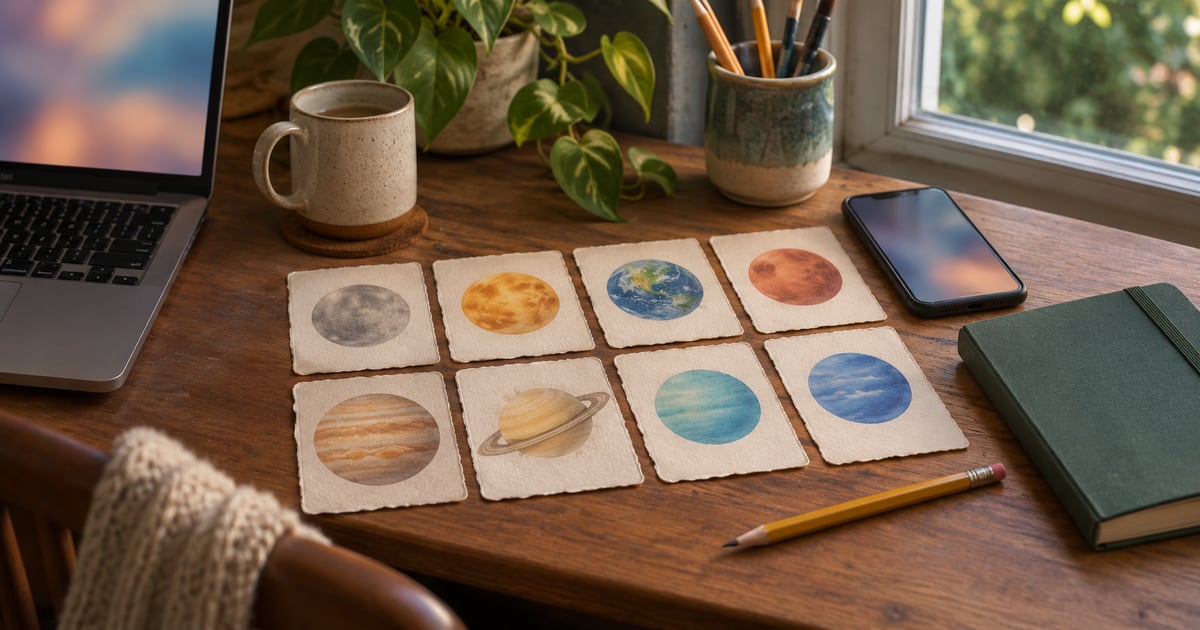
If you add pictures, verify that their labels match your answer key. Do not use the apparent spacing between pictures to infer real distances. A row of equally spaced cards is a memory aid, not a scale model. Your labels should make that clear.
I'm a software engineer, and I build Meomy and Cela myself under Alic Systems. For this exercise, the boundary is simple: a study tool can help you turn checked notes into practice, but the astronomy reference remains the place to verify the facts. Keep those jobs separate when making your materials.
How Meomy AI can help
The app overview describes turning pasted notes, PDFs and audio into flashcards and quizzes, along with Feynman AI sessions for explaining ideas in your own words. You could paste your checked planet-order notes and review any generated prompts against the table before studying them.
Keep the questions focused on sequence, position and neighbours. Do not assume a generated answer is correct simply because it is presented neatly. Feynman AI sessions and other additional features require Meomy Pro; free access is limited. Use the app's current purchase screen for the available plans rather than assuming every practice feature is free.
Conclusion
Start with the eight planets outward from the Sun: Mercury, Venus, Earth, Mars, Jupiter, Saturn, Uranus, Neptune. Choose one cue, then check the complete list, numbered positions and neighbouring pairs without looking. Correct a missed link against a trusted reference and try again after a break. You do not need a grand story about the whole universe to remember this sequence. A clear answer key and a few honest attempts give you a practical way to see exactly what you know.
Frequently asked questions
What is the correct order of the planets?
Starting nearest the Sun and moving outward, the eight planets are Mercury, Venus, Earth, Mars, Jupiter, Saturn, Uranus and Neptune. Specify this direction when practicing. Ordering planets by size is a different task and would require a different list.
What mnemonic can I use?
One original option is My Very Eager Mouse Juggles Small Unusual Notebooks. Its initials match the eight planets. Check that you can translate every word into the correct planet, then practice the names without relying on the sentence alone.
Should Pluto be included?
Pluto is classified as a dwarf planet, so it does not belong in the current eight-planet sequence used here. If your lesson discusses older classifications, distinguish that historical list from the current one and follow the specific question you have been asked.
How do I check whether I remember the order?
Write the complete list without looking, then answer a few position and neighbour questions. Check each answer against a trusted reference. Mark the exact missed link, correct it and try again later rather than only rereading the entire list repeatedly.